Sustainability in beauty has moved well beyond recyclable packaging and vague "natural" claims. Increasingly, the most meaningful environmental action is happening at the ingredient level, in how active ingredients are sourced, extracted, and made. Among the most compelling developments in this space is the rise of upcycled skincare: a practice that takes materials previously destined for waste and transforms them into high-performing beauty formulations.
For Bloomeffects, upcycling is not a marketing position. It is the origin story of the brand itself. Understanding what upcycled skincare means, and why it represents a genuinely important shift in the beauty industry, helps explain why the Proprietary Dutch Tulip Complex™ at the heart of every Bloomeffects product is something worth caring about.
What Does "Upcycled" Mean in Skincare?
Upcycling, in a general sense, is the process of taking a material that would otherwise be discarded and transforming it into something of greater value. In manufacturing, it might mean turning worn tyres into playground surfaces. In food, it looks like turning fruit peels into nutritional supplements or spent brewery grain into flour.
In skincare, upcycled ingredients are derived from agricultural, food, or industrial by-products that would otherwise be treated as waste. The raw material exists regardless, upcycling captures its value rather than letting it be lost.
Examples from across the clean beauty space include:
- Grape seed extract from winemaking by-products
- Coffee grounds from the coffee industry, used in exfoliants and antioxidant serums
- Rice bran from rice milling, used in cleansers and brightening formulas
- Fruit pomace (the pulp left after juicing) used as antioxidant and AHA sources
In each case, the ingredient exists as an inevitable by-product of an existing industry. Upcycling gives it a purpose, reduces waste, and, crucially, often reveals that the discarded material contains exceptional bioactive compounds.
The Bloomeffects Upcycling Story
Bloomeffects' upcycling practice begins in the tulip fields of the Netherlands, on the farm of HM van Haaster, a family operation that has been growing and exporting Dutch tulips since 1905.
Tulip bulb farming involves a process called chopping or disbudding, carried out every spring. The tulip flower heads are removed from the stem before the plant directs its energy upward, this ensures that energy flows back down into the bulb, making it larger, more robust, and more commercially valuable for the following growing season.
The result of this process, carried out across three billion Dutch tulip bulbs each year, is an extraordinary quantity of tulip flower heads, cut, removed, and historically treated as agricultural waste. The flowers are beautiful. But without a purpose, they are simply composted or ploughed back into the fields.
And just like in food agriculture - irregular or "ugly" bulbs get rejected as customers only want the most perfect, pretty bulbs.
When Kim van Haaster began researching the potential of the tulip as a skincare ingredient, she discovered something remarkable: the very compounds responsible for the tulip's regenerative ability, its capacity to continue growing after being cut, its extraordinary resistance to stress, its structural resilience, were also deeply beneficial to skin.
Supported by Dutch government grants, the resulting research identified compounds within the tulips: tulip growth factors Auxin and Kinetin, essential fatty acids, natural moisturising factors, antioxidant flavonoids, and gentle AHAs. None of these required new agricultural cultivation. They were already being grown. They were already being cut. They just needed someone to see their value.
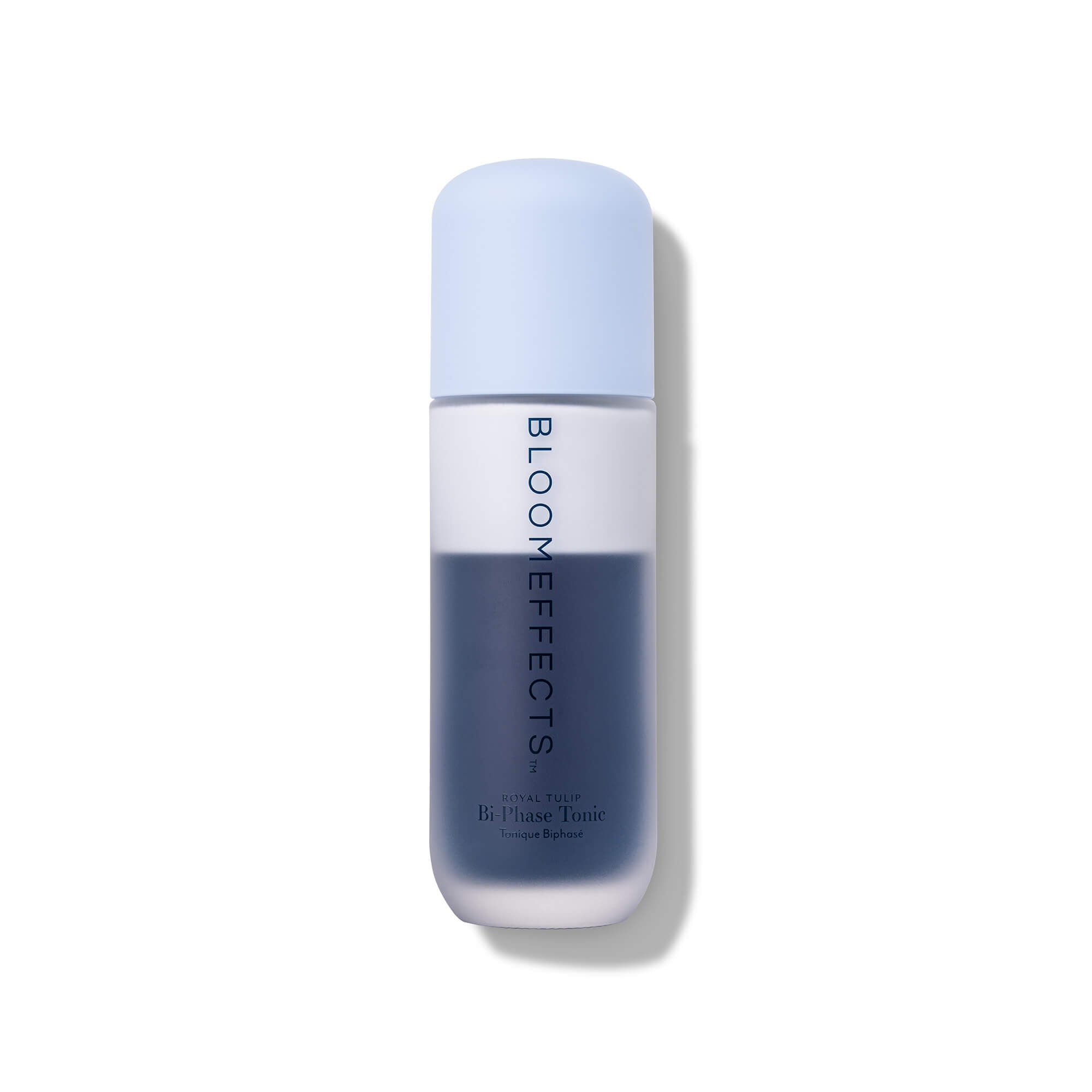
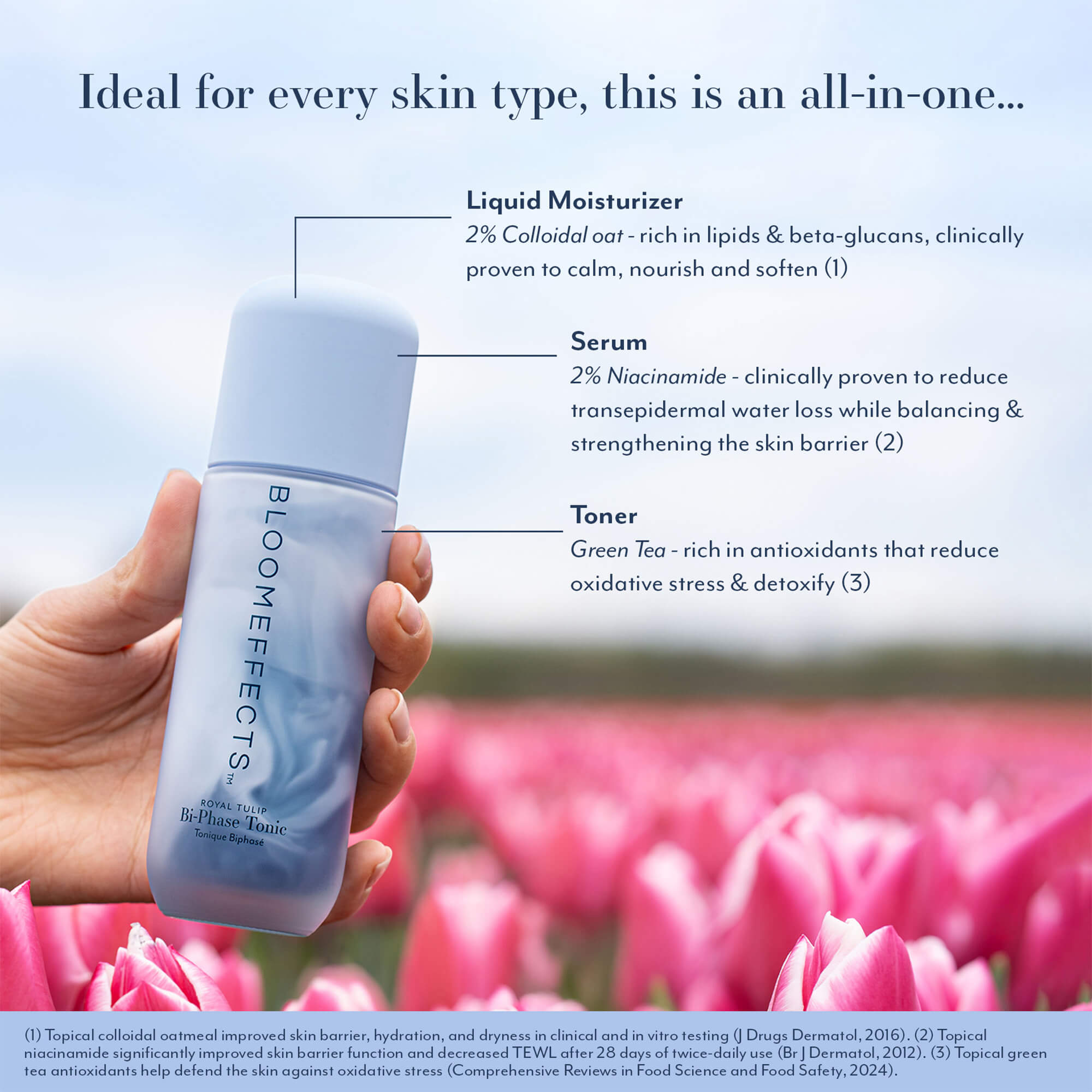
The Proprietary Dutch Tulip Complex™ & the Proprietary Black Tulip Complex™ captures these compounds from otherwise-discarded tulip bulbs & petals and places them at the centre of every Bloomeffects formula.
Why Upcycled Ingredients Are Often Superior Performers
There is a tempting assumption that upcycled ingredients, being derived from what was considered waste, must be the leftovers, the lower-quality material after the best has been extracted. The opposite is often true.
Agricultural by-products are frequently the most concentrated sources of bioactive compounds in a plant. Grape seeds contain far more antioxidant proanthocyanidins than the grape flesh. Coffee grounds are richer in polyphenols than brewed coffee. And tulip flower heads, removed during disbudding, rich in flavonoids.
The Environmental Case for Upcycled Skincare
The beauty industry has a significant environmental footprint. The extraction of botanical ingredients for cosmetics is a major contributor to land use, water consumption, and biodiversity loss when it involves primary agriculture, growing crops specifically for beauty applications that could otherwise be used for food or left undisturbed.
Upcycled skincare disrupts this equation in several important ways:
No new agricultural land required
Because the base material (in this case, tulip bulbs & petals) is already being produced as an agricultural by-product, there is no additional land clearance, no additional water consumption, and no additional carbon footprint associated with growing the crop. The environmental cost of our complexes is built into the existing cost of tulip bulb farming, Bloomeffects captures value from that process rather than adding to its impact.
Reducing waste streams
Billions of tulip flowers are removed and discarded as waste each growing season. By capturing their bioactive compounds before this happens, Bloomeffects reduces organic waste while creating a premium ingredient, turning a cost (waste disposal) into a resource.
Supporting circular economy practices
Upcycling skincare is a practical expression of the circular economy, an economic model in which materials stay in use for as long as possible rather than being discarded. In a beauty context, this means designing formulation practices that see agricultural cycles as closed loops rather than linear processes with waste at one end.
How Bloomeffects Extends Its Sustainability Ethos Beyond Ingredients
The upcycling of tulip extract is the centrepiece of Bloomeffects' environmental approach, but it is not the whole of it.
Our packaging strategy prioritises glass (infinitely recyclable) and sugarcane-derived tubes (renewable, bio-based) over traditional plastic. Where plastic is used, the brand aims for a minimum of 50% post-consumer recycled content and mono-material design to ensure recyclability.
The formulation philosophy, avoiding over 2,700 potentially harmful ingredients while meeting the Credo Clean Standard, means the products are not only safer for skin, but also safer for waterways and aquatic ecosystems. Fragrance-free, sulphate-free, paraben-free formulas have a significantly lower environmental impact profile than conventional alternatives.
Evaluating Upcycled Skincare Claims: What to Look For
As upcycling becomes a recognised value in the beauty market, brands are increasingly using the language without necessarily committing to the practice in a meaningful way. Here is how to evaluate an upcycled skincare claim with appropriate scrutiny:
- Is the source material clearly identified? Legitimate upcycled ingredients come with a traceable origin, a specific crop, a specific production by-product, a specific farm or facility.
- Is there evidence that the material would otherwise have been wasted? Upcycled does not mean "derived from a plant we also use for food." It means the specific material used would not have had another use.
- Is the extraction process itself sustainable? Upcycling the base material does not automatically make the extraction process environmentally sound. Look for brands that are transparent about their processing methods.
- Is the ingredient genuinely efficacious? Upcycled should not be a justification for an inert or low-performing ingredient. The whole point is that these materials are often more concentrated in bioactives than primary agricultural sources, that potential should be realised in the formula.
The Takeaway
Upcycled skincare is one of the most genuinely meaningful expressions of environmental responsibility in the beauty industry. Rather than growing new crops, clearing additional land, or consuming water resources for cosmetic ingredients, it finds extraordinary value in what was already being discarded.
For Bloomeffects, this is not a positioning strategy applied after the fact. It is the reason the brand exists. The tulip fields of Holland were already producing billions of flower heads each year, already removing them during disbudding, already treating them as waste. The discovery that those discarded blooms contained the blueprint for exceptional skincare changed everything, for the farm, for the formulas, and for the beauty industry's understanding of what an ingredient can be.
Waste is only waste until someone pays attention.
Discover how Bloomeffects turns upcycled Dutch tulips into effective, sustainable skincare at bloomeffects.com. Read more about the brand's ethos at bloomeffects.com/pages/ethos.